












































































.bmp)





























.bmp)
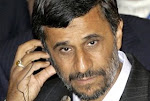
 NEW DELHI:The Iranian President, Mahmoud Ahmadinejad, arrived here for a dinner meeting with Indian government officials on Tuesday, but he was expected to sign no path-breaking bilateral deals, nor iron out the kinks in a proposed 1,600-mile-long natural gas pipeline.Instead, he brought the Indian government a strange boon: a chance to show that it is willing to buck pressure from the White House and shake hands with a man Washington reviles.One Indian official described it as "high visibility visit" with a slim chance of tangible outcomes.Even as the United States presses India to exert greater pressure on Iran to limit its nuclear program, the government of Indian Prime Minister Manmohan Singh is under increasing pressure from its political critics at home to assert its independence from the United States. Iran has become the perfect proxy."It is good for the government to be seen taking a stand that the U.S. may not like," observed Lalit Mansingh, a former Indian ambassador to Washington.In fact, for energy-hungry India, good relations with Iran are important for at least three reasons. It is the second largest supplier of oil to India, after Saudi Arabia, and a potential source of natural gas in the future; it wields influence in Afghanistan, which India increasingly considers critical to regional stability; and it commands loyalty from India's substantial community of Shiite Muslims.Just as important, how the government of Manmohan Singh handles Tehran has come to be seen here as barometer of India's foreign policy independence. Singh's critics from the left and right have pounced on his government for deepening commercial and military ties with the United States. That criticism has stalled a United States India nuclear accord, and possibly killed it.Speaking to an international strategic affairs conference here earlier this month, India's national security adviser, M.K. Narayanan, called for delicacy in dealing with Iran. "Please do not treat Iran in the manner that you treat Mugabe," Narayanan said, referring to President Robert Mugabe of Zimbabwe, in front of an audience that was peppered with American and European diplomats. "It is a big country, it is a major country, with tremendous influence, and you need to deal with it diplomatically.""Otherwise," he warned, "the world will have to pay a heavy price."Then, last week, after a State Department spokesman, Tom Casey, called on India to use Ahmadinejad's visit to urge Iran to stop nuclear enrichment, the Indian Foreign Ministry declared that the two "ancient civilizations" needed no "guidance" on how to deal with one another.Iran earlier this month announced that it had significantly expanded its plans to enrich uranium. Iran's nuclear ambitions will likely emerge as one of the top foreign policy challenges facing the next American president and inevitably loom over India-United States relations. Dominating the Iran-India agenda is the proposed pipeline that would ferry natural gas from Iran across Pakistan to India.Several crucial details of the proposed project, valued at more than $7 billion, are yet to be resolved, including the price of gas and whether Iran will guarantee its supply. The project has been consistently opposed by the Bush administration.A second equally important agenda item is an agreement, signed in 2005, for the supply of 5 million tons of natural gas a year over a 25-year period.That accord has been held up over price disagreements, because world energy prices have gone up sharply since the deal was signed. Ahmadinejad's visit to New Delhi, where he will meet with the president, prime minister and several cabinet ministers, is a pit stop on his way home from Sri Lanka, where Iran is helping to modernize an oil refinery and a hydropower project, with a $1.6 billion line of credit.Iran's new thrust into India and Sri Lanka comes as it is increasingly isolated by the United States and Europe.Iranian Foreign minister Manouchehr Mottaki, who attended university in the southern Indian city of Bangalore, is credited with driving this "Look East" strategy.Bilateral trade between Iran and India, the bulk of which is oil and gas-related products, increased 55 percent in the last fiscal year to $9.3 billion, according to figures from the Indian government. That amount is about a third of India-United States trade.In February, the Confederation of Indian Industries, the country's largest business group, took a delegation of 10 companies to Iran to discuss possible business partnerships.With increased diplomatic pressure from the West on Iran, "this is the right time for Indian companies to step in," said one executive who went on the trip but did not want his name used because he did not want to comment on government matters.By Somini Sengupta and Heather Timmons
To read more go to:
As in the days of Noah...

